
Disciplines
High Power Rifle
In the State of Montana, there are several types of high power rifle matches. The rifle matches are either three position matches or prone matches. National Match rifle competitions are commonly called "Across The Course" (XTC) matches and include NRA and Civilian Marksmanship Program (CMP) matches. Both XTC and Vintage Rifle matches are "three position" matches, where firing takes place standing, sitting and prone at distances from 100yds up to 600yds.
Mid Range, Palma, Long Range, Fullbore and F-Class matches are all prone matches, and can be fired at distances from 300yds up to 1000yds. All prone matches have a division for F-Class, where F-class (scope and bipod) shooters compete side by side with shooters using slings and iron sights.
Matches are open to all responsible citizens in support of the Second Amendment. New shooters are always welcome, and should contact the match director for information in advance of the match. Often times, gear, rifles and sometimes ammunition can be supplied to new shooters, so they can easily give competitive shooting a try. The rifles/gear/ammo are subject to availability and juniors are given priority. Contact the Match Director prior to the match for more info about the use of loaner gear.
High Power Match and Equipment Information
Across The Course (XTC, EIC "Leg") Matches
In NRA Across the Course (XTC) Highpower Rifle Competition, shooters compete with either a Service Rifle or a Match Rifle. The Service Rifle division is limited to either the M1, M14, M16, M110 or their commercial equivalents such as an AR15, AR10 or M1A. Match Rifles typically are of custom make, conforming to the desires of the shooter. They are more free of regulations than are the Service Rifles. Shooting is typically done with metallic aperture, or peep, sights. New NRA rules allow the use of optics in NRA XTC matches. Match Rifles need to have either an internal magazine or external magazine capable of reloading 5 rounds quickly. CMP Excellence in Competition (EIC) matches (AKA "Leg" matches) require the use of the United States Service Rifle (M1, M14, M16, or commercial equivalents) with standard iron sights. Shooters competing XTC, usually fire at distances of 200, 300, and 600 yards (exception in Montana is Anaconda, where all firing is done at 200yds using reduced targets). In a typical 800 point aggregate match, the course of fire is a total of 88 shots. Twenty record shots are fired in each stage, plus two sighting shots. Each shot is worth a maximum of ten points, with the entire match being worth a total of 800 points. Stages include off-hand (standing), sitting rapid fire, prone rapid fire and prone slow fire.
- The first stage of fire consists of two sighting shots and 20 shots for record in 20 minutes. These shots are fired at a distance of 200 yards in the standing/offhand position. The target used has a 3 inch X-ring, a 7 inch ten-ring. Each succeeding scoring ring is three inches wide. The aiming black is 13 inches wide, consisting of the 9,10, and X rings. The lowest value ring is the 5-ring. X's are scored a value of ten and are used for tie breaking purposes.
- The second stage of fire consists of two ten-shot strings fired rapid fire from the sitting position with a time limit of 60 seconds for each string. This string is also done at 200 yards using the same target as was used for offhand. The string can start with the shooter either in the standing or sitting position. Once the clock starts, the shooter gets into position and shoots the 10 shots. If the shooter is using a semi-automatic rifle, 2 shots are fired then a magazine change is required and the remaining 8 shots are fired. If the shooter is using an NRA type rifle, 5 shots are fired then a re-load is performed and the remaining 5 shots are fired.
- The third stage of fire is rapid-fire prone (lying down) at 300 yards. Each of two ten-shot strings are fired in a time limit of 70 seconds. The dimensions of the target are the same as the 200 yard target, with the exception of an additional ring of black to facilitate aiming.The string can start with the shooter either in the standing or prone position. Once the clock starts, the shooter gets into position and shoots the 10 record shots. The shooter uses the same re-load procedure as with the 200 yard rapid sitting.
- The final stage is fired at a distance of 600 yards. Twenty shots for record are fired slow-fire from the prone position in 20 minutes. The target used has a 6 inch X-ring, and 12 inch 10-ring. The 9 and 8 rings are each three inches wider. Each ring of value below that is six inches wider. The aiming black consists of the 7, 8, 9, 10, and X rings, which constitutes a 36 inch aiming black. (Some info courtesy of Mark Havlik, Minnesota Rifle and Revolver Association)
Prone Matches - Mid Range, Palma, Long Range, F-Class and Fullbore
Prone matches are fired slow fire - one shot at a time, with the target marked between shots. Prone matches include Mid Range (300-500-600yds), Palma (800-900-1000yds), Long Range (1000yds) and Fullbore (300-1000yds). Prone matches are typically broken into a few basic divisions, which are Service Rifle, Sling and F-Class. Service Rifle distinctions are noted above, while "sling" is a term often used to note match and Palma rifles that are fired using a sling for support and often iron sights. Some matches allow the use of "any-sights" on sling rifles, and shooters can then use optics if they so choose. F-Class consists of two sub divisions: F-Open and F-TR. The basic difference is that F-TR is more restrictive as the rifles need to be .308 Winchester or .223 Remington. They are also required to use a bipod and have a lower weight limit than their F-Open counterparts. F-Open allows a heavier rifle and the use of front and rear bench rest type rests. There is also no specification on caliber other than it needs to be smaller than .35 caliber.
High Power Equipment
Highpower shooters are known for the large amount of equipment that they haul out onto the range. Below is the basic equipment used along with a description of its use. All though each of these items are generally necessary, it isn't necessary to go out and buy all new equipment. In getting started, it's generally best to ask other shooters opinions about equipment. It's also much cheaper to buy used equipment rather than new.
- Rifle- Shooters preference as to Service Rifle or Match Rifle (NRA)
- Sling- For the Service Rifle, the sling must be of military style. For the Match Rifle, adjustable slings with arm cuffs and buckle adjustments are the norm.
- Shooting jacket- The purpose of the jacket is to provide support, and to pad the shooter to minimize the effect of pulse and recoil. The best coats are the NRA-style of either heavy Cordura or leather make. They are used by sling shooters and are not typically used in F-Class.
- Glove- The glove is necessary to pad the hand from the pressures of the rifle. They come as either mits or gloves. This is a personal preference. As with shooting coats, they are not typically used in F-Class.
- Shooting Mat- The shooting mat is used to provide some padding between the shooter and the ground.
- Spotting Scope and Stand- The spotting scope allows you to see the spotters and scoring disk in your target. They are also often used to locate shot holes during the rapid fire stages. More importantly, when shooting long range, they allow you to judge the wind by watching the mirage. Scopes vary in power and objective diameter. The power used should be between 25 - 60X. Diameters should preferably be 50mm or larger. A scope stand that allows you to adjust the scope so that it can be viewed in all positions is necessary.
- Lastly, if you are intersted in attending a match, inform the Match Director and speak with him regarding equipment needs. Often there is loaner equipment that can be lent out. This allows you to try competitive shooting with out diving into all the purchases of equipment. It is also a good chance to see what you do and do not like about certian pieces of equipment. (Mark Havlik, Minnesota Rifle and Revolver Association)
Important Links
Black Powder Cartridge Rifle
BLACK POWDER SILHOUETTE


A deep boom, a cloud of smoke, the clang of a steel target hit with a 500 gr cast bullet, and watching it fall off the rail through the iron sights.
That’s what hooked me the first time I shot a Black Powder Cartridge Rifle silhouette match in Livingston, MT.
If you are looking for immediate feedback in a shooting competition, well, you might have to wait just a bit. It takes those same 500 gr. lead bullets about 1.3 seconds to get to the Ram silhouette at 500 meters and almost 1.5 seconds for the sound of the bullet striking to get back to the firing line.
Unlike most shooting sports, which use paper targets, BPCR silhouette uses reactive steel targets. Four different steel animal silhouettes (chickens, pigs, turkeys and  rams) are set out at four different distances (200m, 300m, 385m, and 500m). A typical match consists of 10 of each animal silhouette for a total of forty targets.
Competitors take one shot at each target. If the target is hit and knocked over the competitor scores one point. Thus, a maximum score for a forty shot match is forty points.
Course of Fire
10 Chickens 200m (offhand)
10 Pigs 300m (sitting or prone from cross sticks)
10 Turkeys 385m (sitting or prone from cross sticks)
10 Rams 500m (sitting or prone from cross sticks)
Time Limits: 1st half of relay, 7 minutes for unlimited sighters and 5 score shots. Once competitor goes for score no more sighter shots allowed. 2nd half of relay, 5 minutes for 5 score shots, no sighters.
Since the sport of BPCR silhouette began in 1985, only one competitor has shot a perfect 40 in a match. (Brian Chilson, of Nelson, PA, in 2009). The good news is you can compete against others at whatever level you may be, from beginner to seasoned expert.
Individual Classifications (40 shot match):
Master 31-40
AAA 26-30
AA 21-25
A 16-20
B 0-15
EQUIPMENT
Basic equipment needed: Rifle, 60 rds ammo, blow tube, cross sticks, shooting mat, spotting scope, chair, tripod, spotting board and timer. In practice the most popular rifles are those built on Winchester Highwall, Ballard, Remington Rolling block, Sharps, and Hepburn actions. Popular cartridges include 45-70, 45-90, 40-65. Cartridges must be loaded with straight black powder or Pyrodex. Plain based cast bullets must be used.
- Single shot rifles made in the US before 1896 that have an exposed hammer, or replicas of those rifles.
- Iron sights or period scopes allowed.
- Cartridges must be those that were originally loaded with black powder of 32 cal or larger.
- Rifle weight must be 12 pounds 2 ounces or less with sights.
- No mechanical rests, no shooting jackets or shooting gloves permitted.
- Complete rules can be obtained from the National Rifle Association at 800-267-3888 or at http://competitions.nra.org/documents/pdf/compete/RuleBooks/Sil-r/sil-r-book.pdf
- Desire to have fun, shoot with people who will be happy to loan you what you don’t have, give you advice, loading data, sight settings and whatever else you might need to get started.
BPCR Silhouette shooting is a team sport - one team member shoots while the other watches for changes in the wind and mirage, spots the hits and misses and keeps track of score. It’s a great way to spend time with a son or daughter or a wife or dad, whether both shoot or one of you only does the important job, spotting. I encourage everyone to come check out a match, one of the competitors will likely offer you the chance to shoot a few rounds and get hooked on a great sport!
- Mark Griffis, MRPA BPCR Chairman
Black Powder Target Rifle (Creedmoor/Mid-range)

Black powder target rifles are single-shot, breech loaded cartridge rifles that shoot lead projectiles propelled by black powder or black powder substitute. No smokeless powder in any quantity may be used. No gas checks are allowed.
Any metallic sights that are period correct, pre-1896, are allowed. No optics other than sight corrected shooting glasses permitted.
Period correct scopes are allowed with a tube body diameter of 3/4" or less and objective lens ring no larger than 1" in diameter. Mounts must also be period correct with windage and elevation adjustments incorporated into the mounts. No internal scope adjustments for windage or elevation are allowed. No click adjustments are allowed.
Matches and tournaments are per NRA Black Powder Target Rifle rules. Squads consist of a two-shooter relay.
For Creemoor matches (800 900, 1000yds.) each shooting team will have a 3-minute ready period followed by 60 minutes to fire unlimited sighters and 10 shots for record.
For Mid-range matches (200, 300, 600yds) each team will have a 3-minute ready plus 50 minutes for record.
Each target will be assigned a two-man team in the pits.
Shooter classifications are Master, Expert, Sharpshooter, and Marksman and are officially assigned by the NRA from sanctioned events. If a shooter does not have long range classification from the NRA his BPCR Silhouette classification may be used. If no classification has been assigned, shooters will enter competition as a temporary Master per NRA rules.
Any legal NRA Black Powder Target Rifle position may be used. NRA approved cross-sticks or slings may be used. If a sling is used the forward forearm must be clear of the ground from the elbow forward. Grounding the rifle in any form is prohibited
Mid-range can be broken down into 2 disciplines, position and prone:
- Position is fired from standing (200yds. on SR target), sitting (300yds. on SR-3 target), and any position, usually prone (600yds. on MR-1 target).
- Prone is fired from any position using the same distances and targets.
Mid Range (200-300-600yds) Targets:
SR (13” black) SR-3 (19" black) MR (24” black)


Long RangeTarget (800-800-1000yds):
Creedmoor LR (44” black)

- Mark Griffis, MRPA BPCR Chairman
Silhouette
SILHOUETTE
Rifle Metallic Silhouette shooting is considered by many to be the ultimate rifle challenge. The sport originated in Mexico in the days of Poncho Villa as entertainment. Live animals were tethered and shot at from long distances. Live animal shooting evolved into metallic silhouette shooting to save on targets. The sport was very popular in Mexico and US shooters traveled south of the border to compete.
The sport emigrated to the US in the early 70's. The first sanctioned shoot was held in Tucson in 1973 when the NRA sponsored the first national championship. Roy Dunlop, noted gunsmith, is considered to be responsible for popularizing the sport in the US.
Unlike other forms of competition, a class system exists so shooters compete against shooters of or near the same ability. Beginning shooters need not shoot against master class shooters. Everyone has a chance win his or her class. Classes are Master, AAA, AA, A, and B.
Both highpower and smallbore categories exist. The targets consist of chickens, pigs, turkeys and rams. The highpower targets are made of high strength steel to avoid damage. The chickens are placed at 200 meters; the pigs at 300 meters; the turkeys at 385 meters; and the rams at 500 meters. All shooting is done offhand without slings or shooting jackets.
In smallbore, the targets are 1/5 the size of the highpower targets, and placed at 1/5 the distances. Thus the chickens are shot at 40 meters; the pigs at 60 meters; the turkeys at 77 meters; and the rams at 100 meters. The body of the chicken is about the size of half-dollar. Each target gets larger in size, and most shooters consider the turkey to be the most difficult because of its shape.
Targets are placed in banks of 5. A complete round is 40 targets- 10 of each animal. A shooter gets 2-1/2 minutes to shoot a bank of targets. After a brief rest, the second bank is shot. Then, each shooter moves to a different target until all 40 targets have been fired at. The targets must be knocked off their stands in order from left to right.
In the highpower division of rifle silhouette there are two subdivisions:
- So-called standard or silhouette rifle can have bull or reverse taper barrel and/or have tuner (no muzzle-break) or added disc like weights that act like tuner, but the rifle/scope combo can not weigh greater than 10lb 2oz, no saftey is required and no restrictions on trigger weight albeit it has to be safe and no release type triggers allowed. stock can be thumbhole - see NRA rule book for additional restrictions (barrel not more than 30 inches)
- Hunting rifle can be used in both standard and hunter rifle sub-divisions. rifle/scope can not weigh more than 9lbs, barrel length not above 26in, and the barrel must be tapered towards muzzle. Additionally, the trigger pull can not be less than 2lbs., magazine can only be loaded with 5 rounds and during a match rounds must be chambered from magazine - see NRA rule book for other details
In smallbore division of rifle silhouette there two sub-divisions
- So-called standard or silhouette rifle identical to high power except chambered for 22 rimfire short,long or long rifle.
- Hunting rifle with scope can not weigh more than 8lb 8oz. and it may be a single loading 22rimfire. Hunting rifle may be used in both standard and hunter rifle matches. The barrel and trigger restrictions same as high power hunter.
Ammo for rimfire does not include "stingers or other hot loads" that could damage targets. Ammo for high power division excludes magnums, any caliber less than 6mm. or any ammo that damages targets. Most popular calibers for high power are 6.5 x 47 Lapua, 260 Rem. and 7mm 08 - most competitors use heavier bullet for rams (they weigh 52lbs) - 308 still sees some use however, the accumulative recoil over 40 shots is a negitive factor. Likewise, 105gr bullet for 243 may not consistently knock over rams in all conditions, but is still used. The 6.5mm Swedish Mauser is as good as any and inexpensive Tikka brand is good starter for shooting both classes of high power.
Most popular scopes for both high power and smallbore rifle are Weaver T series or Leopould fixed or variable - most shooters prefer target knobs and 16-36 power and target dot 3/8-1/2 MOA.
While shooting at these distances off hand is challenging, it is amazing how one can improve with practice and the instant gratification of the animal falling is exciting!! Acting as spotter for a shooting companion is fun and gives positive feedback.
Youth Marksmanship
YOUTH MARKSMANSHIP

Nick Mowrer, of Ramsay, Montana represented the United States at the 2012 Summer Olympic Games. Nick got his start in competitive high power shooting at ranges in Montana. He then perused pistol competitions and ended up as a resident athlete at the US Olympic Training Center, In Colorado Springs, Co. Mowrer's recent Olympic performance was one of the best in a few decades by an American in Olympic Free Pistol Competition. The 2012 Summer Olympics are just a part of this young man's many accomplishments and one of many more to come. Mowrer's success is partially owed to opportunity - the opportunity to compete with firearms in the State of Montana. Consider supporting competitive shooting in Montana by membership in the MRPA, helping out at matches, or encouraging youth marksmanship.
Mowrer, then a newer shooter, is seen here receiving coaching from Eric Buljung, National Champion in 2006. Buljung is 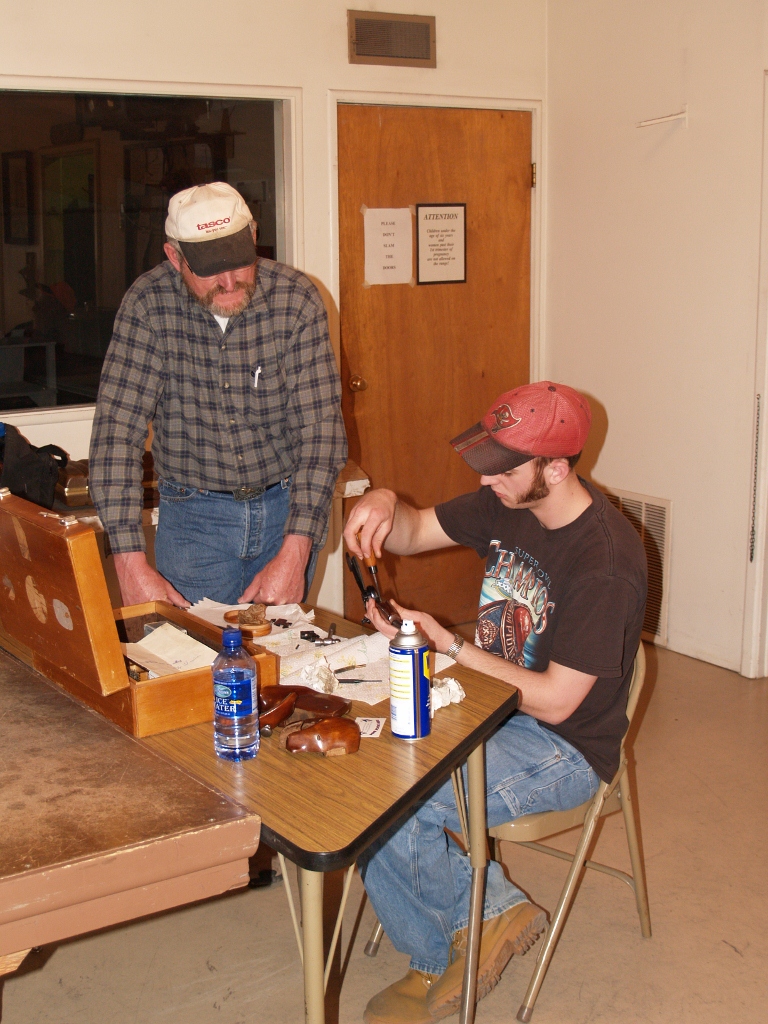
helping Mowrer with a free pistol. Six years later, Mowrer became the highest placing US free pistol shooter in a few decades. Adult mentoring is a key to continuing the proper, safe use of firearms by the next generation. Competitive shooting instills responsibility and discipline in the young athlete. Help protect our Second Amendment by educating and fostering youth marksmanship Take a youth shooting today and you never know where it will take him tomorrow.
Youth shooting opportunities in Montana:
-
-
- BB Gun
- Air Pistol
- Air rifle - 2 classes
- Smallbore rifle
- small bore pistol
- High power/SILHOUETTE/bullseye
- ????
-
Youth Shooting organizations
-
-
- 4H
- Jaycees
- NRA, CMP, USA shooting
- ????
-
Youth shooting opportunities in Montana:
-
-
- BB Gun
- Air Pistol
- Air rifle - 2 classes
- Smallbore rifle
- small bore pistol
- High power/SILHOUETTE/bullseye
- ????
-
Youth Shooting organizations
-
-
- 4H
- Jaycees
- NRA, CMP, USA shooting
- ????
-
Benefits? Travel? personal development? scholarships ? Collegiate shooting?
How does a kid get started in different parts of the state?
Bullseye Pistol
The classic outdoor pistol match is called a "2700." Shooters fire 270 shots with a maximum value of 10 points for eachs shot, hence the name. Those 270 shots are divided into three 90-shot events, fired with .22, center-fire, and .45 pistols.
This format got its start as a way to combine shooting with the civilian's .22, the police officer's .38 revolver and the military man's 1911 .45 auto. As the 1911 accuracy improved, however, shooters began to use the .45 for both center-fire and .45 matches, and today it is rare to see a pure center-fire pistol.
The 90-shot, 900-point aggregate consists of four matches: slow-fire, the National Match Course, timed-fire and rapid-fire. Slow-, timed- and rapid-fire are 20-shot events, but the National Match Course has 30: 10 shots slowfire at 50 yds;. and 10 each timed- (five rounds in 20 seconds) and rapid- (five rounds in 10 seconds) fire at 25 yds.
The sustained-fire stages are timed by turning the targets perpendicular to the firing line until the time for shooting begins. They turn to face the shooter, then swivel back to their starting position when time expires.
While a full-fledged 2700 is fired at 25 and 50 yds, proportionally reduced targets make it possible to fire all stages at 20 or 25 yds. or indoors at 50 ft. The targets used in outdoor competition have a tie-breaking X-ring of 1.695" diameter and a 10-ring 3.36" in diameter. The 50-yd. target's 8, 9 and 10 rings are black, while only the 9 and 10 rings are black on the 25-yd. sheet, so the sight picture is similar, despite the difference in distance.
While a big 2700 match is an all-day affair, NRA recognizes many shorter courses of fire, and many clubs and leagues firing indoor matches use the Gallery Course. It has a single 10 minute, 10-shot slow-fire stage and two five-shot strings each of timed- and rapid-fire. With preparation periods, one relay can take less than 20 minutes.
One of the appealing features of conventional competition is the multiple opportunities to win. At the National Matches, and even at large state or regional events, awards are presented for every match and for sub-aggregates. When each of these is multiplied by the many different classes and categories possible at a big match, there can be hundreds of opportunities to win.
The NRA classification system groups shooters of similar ability into one of four classes that range from Marksman up to the top-level Master. Shooters may be further grouped into categories--juniors, women, collegians, police and service members.